2025 AGM and President’s Report

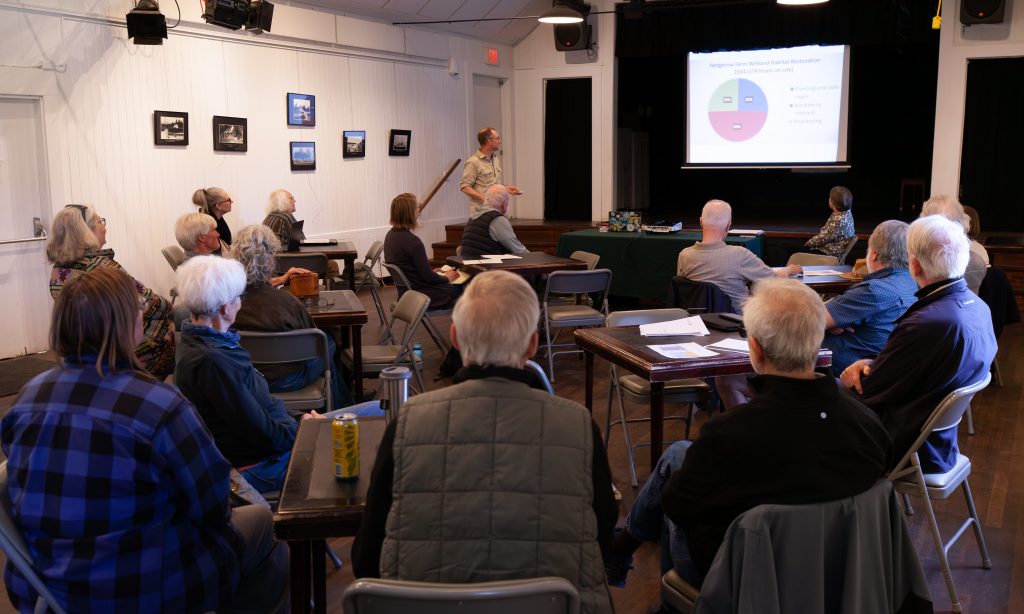
Each year our Annual General Meeting provides us with the opportunity to report to the membership and the community at large. Sunday, April 27th was a beautiful spring day, and the attendees included true stalwart supporters of our work, some of whom had just returned from the Annual Beach Clean Up! The meeting included a comprehensive report on restoration and land management work by Rob Underhill, and a report on youth nature education by Justine Apostolopoulos. After the business meeting Peter Robinson presented Helen O’Brian with a custom designed brooch inspired by the Conservancy’s logo to acknowledge her contributions to the organization as founder and board member for twenty-two years. Cake was served to celebrate, along with a barbeque for Beach Clean Up participants. The following is my 2025 President’s Report:

The Mayne Island Conservancy has been serving the island community for nearly twenty-two years now. And over this time, it has continued to add to the amount of protected land while offering educational experiences and activities that show new generations of islanders the many ways local ecosystems can be conserved and restored.
We rely on and appreciate support from both islanders and a broader community of people who care about Mayne Island. This support comes in the form of grants, donations, memberships, and volunteer efforts.

Our successes rely on partnerships with like-minded organizations. For instance, when the Conservancy arranges for the protection of land over the long-term, the process often involves purchasing a property, which is then transferred to another land trust before we take on responsibility for management and restoration work. In the case of Edith Point, the landholder is now the Nature Conservancy of Canada with the Mayne Island Conservancy partnering on the creation and execution of the management plan. Examples of partnerships and collaborations in 2024 include:
- Indigenous-led and focused deer education workshops in collaboration with the W̱SÁNEĆ Leadership Council, Tsartlip hunters and SENĆOŦEN language educators.
- The Southern Gulf Islands Bull Kelp Monitoring Collaboration, and the Hakai Institute’s light trap project for monitoring Dungeness crab.
- Land stewardship, habitat restoration, native plant propagation, and youth nature education with the Galiano Island and Pender Islands Conservancies.
- Documentation of the impacts of deer on Garry oak ecosystems for Tara Martin’s lab at UBC.
- Protection and restoration of natural habitats with public land managers such as Parks Canada, Capital Regional District Parks, the Mayne Island Parks and Recreation Commission, organizations like the Nature Conservancy of Canada, and private land stewards.
As of this month, just under 11% of SḴŦAḴ | Mayne Island is protected, which is admittedly not a dramatic advance since last year. That said, several projects are underway which will change this number within the next few months, and others are ready to go. Last year our Executive Director, Michael Dunn, indicated that he would like to move into the much-deserved role of senior consultant, which will allow him to concentrate on both land trust work and activities related to the natural sciences. Michael has been actively contributing to the Conservancy since 2005, first serving as President, before moving into the role of Executive Director in 2012. Over these years he has brought a wealth of knowledge to the role and has done so on a volunteer basis; an extraordinary contribution to the organization! This work included the establishment of the Conservancy’s land trust status, qualifying the organization to offer Ecological tax credits to land donors and nurturing long-term relationships with landholders and a range of collateral organizations, both governmental and non-profit. He negotiated the first covenant held by the Conservancy at Horton Bay as well as a second one for St. John Point and led the negotiations and the purchase of both St. John Point and Edith Point on behalf of the Conservancy.

Our focus over the past year has been to create a Land Protection Program and to find a new Executive Director who can be in place at the end of August. Through the Land Protection Program, Michael is providing his successor with the tools needed to build the program over time. As I just mentioned, our primary focus over the past six months has been the search for an Executive Director, and I am very happy to announce that Amy Kamarainen will begin transitioning into the role on June 1st. Amy is an accomplished scientist and researcher who has done groundbreaking work in environmental education. She comes to us from the Salmon Coast Foundation, where she has served as Executive Director since 2021. Moving forward, the Conservancy will now have the resources needed to fully deploy the Land Protection Program in pursuit of our vision of conserving 30% of Mayne Island by 2033.

It is also time to thank two directors who have made unique and notable contributions to the organization. The first is Robin Walsh, who did a splendid job of leading the Membership & Communications Committee for 3 years. You likely saw him at many of the farmer’s markets, selling memberships and introducing people to the conservancy. He also prepared a Communications Plan to inform and guide our work. The second is Helen O’Brian, who has been an integral part of the Mayne Island Conservancy since it was founded as the Friends of Mount Parke in 2003. Helen is stepping down from the Board of Directors after playing a central role in defining the essence of the organization, its values, and just as importantly, its personality. Her many accomplishments include the successful St. John Point Campaign and the establishment of a technically challenging conservation covenant on Hatake Farm which is partially in the Agricultural Land Reserve. We can’t thank Helen enough for her wise and thoughtful leadership over so many years. Fortunately, she will continue to play a part in the Conservancy’s activities, albeit on a more casual basis!


0 Comments