Ecological Thinning

Clad in suspenders and boots, he has the build of a logger – but Tal Engel approaches the forest like a doctor in a clinic. He picks off leaves and digs handfuls of soil, looking for clues that indicate the health of the ecosystem. We invited Tal, founder of WolfTree Integrative Forest Rehabilitation, to Henderson Community Park to ask for his expert advice on forest restoration, and he spoke at two well attended community events, sparking enlivened conversations. Tal’s visit was part of a planning process that includes the Mayne Island Parks and Rec Commission and community volunteers as we learn together how to support the growth of an old growth forest.

Tal posing with a mature Douglas fir in Henderson park during his visit.
Growing trees
If you have up hiked to Vulture Ridge, you know about the tunnel of trees. In 2005, most of Henderson Park was logged, with some areas clearcut, including what is currently the access road and picnic area. More on that here. Today, much of the site has filled in with a dense stand of young grand and Douglas fir, and competition for light is fierce. If you scan the ground, you will be met with a view of dead needles and branches- even the most shade tolerant species have a tough time growing with such little light.
Crowding is an expected successional phase as a coastal Douglas fir ecosystem recovers from disturbance. For a few decades as thin gangly fir trees grow tall and compete for light, they naturally thin themselves, resulting eventually in a more openly spaced forest. However, the competition can be so fierce that it also wipes out other species, like big leaf maple and arbutus, that are key to preserving biodiversity. Left on its own course, we risk losing these species and growing a monoculture of fir that is more susceptible to pests and disease, like laminated root rot. Right now there are still many biodiversity features on the site, so we have a golden window of opportunity to intervene.
Volunteers surveying for stems per hectare in a dense stand at Henderson Park.
Counting trees
Following Tal’s visit, we began hosting volunteer habitat restoration work parties to survey the young regenerating forest at Henderson. We are collecting baseline data that will inform a restoration plan and provide opportunities for community engagement.
The night before the first survey it rained hard, and while it had cleared up by the morning, we were still soaked by the salal carwash. Weaving in and out of densely spaced trees felt more like yoga than data collection, but it made it apparent how much this forest needed thinning.
The first survey was for measuring stem density. We chose plots at random and counted the trees within them, using the data to estimate the stems per hectare. A healthy mature coastal Douglas fir forest would have between 200 and 600 Douglas fir trunks per hectare, with wide open spaces between them to let light into the undergrowth. We calculated about 2800 stems per hectare at Henderson, with almost all the trees being less than 20cm in diameter.
The second survey was for identifying key biodiversity features, or “anchor trees”. This involved searching for trees such as big leaf maple, red alder, arbutus, or Garry oak that we could help give light and space to. This was the definition of “tree hugging” as taking a measurement of circumference required wrapping your arms around the trunk.
Through the volunteer work parties, we noticed that although the fir trees dominated, there were many other species in the mix that could use some room to breath. Most of the fir are still skinny (less than 15cm), so thinning would only require hand tools, meaning we wouldn’t have to bring chainsaws or fallers into the project. We also learned that our volunteer community is super keen to help us do the work!
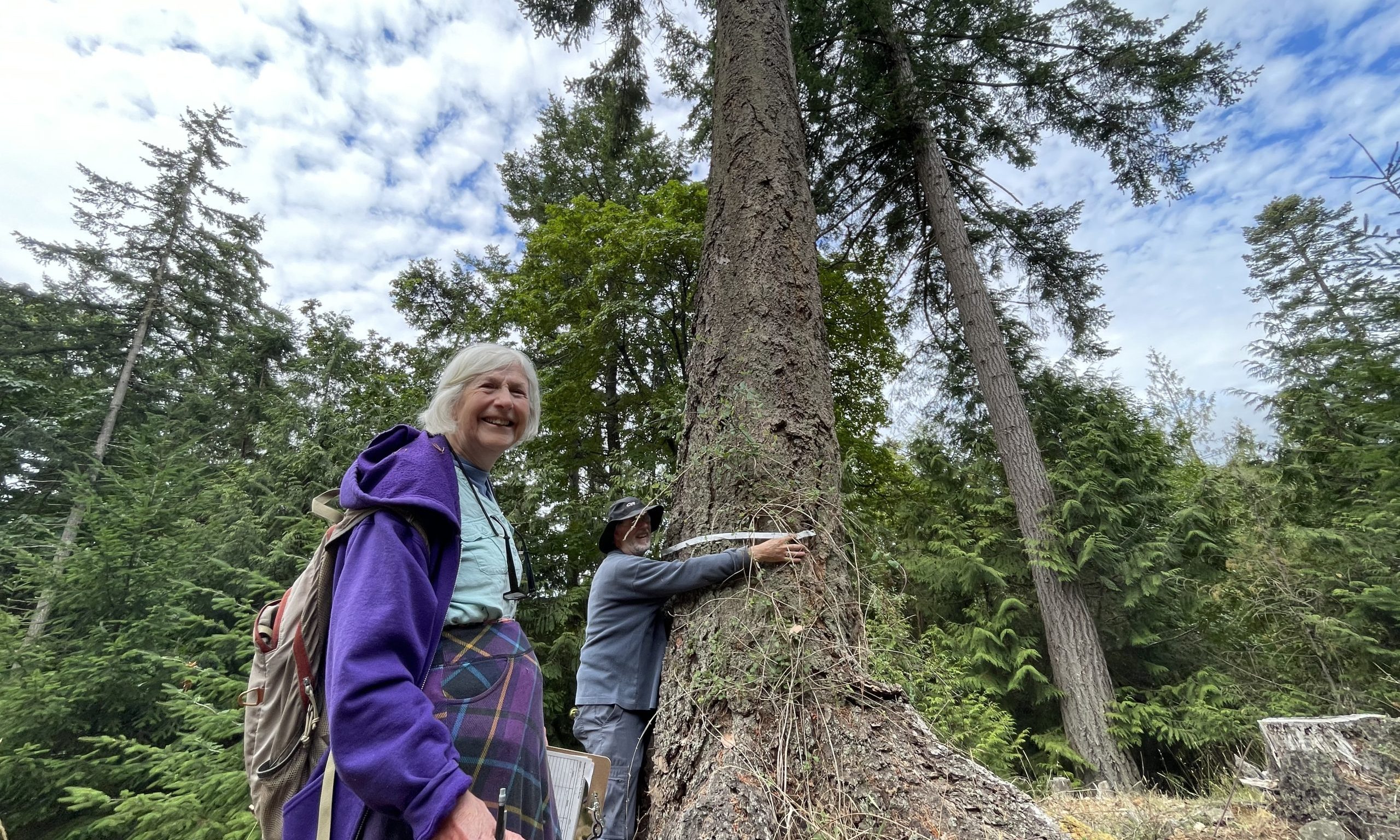
Volunteers surveying for biodiversity anchors in Henderson Park.
Thinning trees
At a recent volunteer work party at a restoration site at Hedgerow Farm wetland, we got a chance to put on our lumberjack hats. When the site was first planted, we used alder to fill in an open field, shading out the sun-loving invasives and fixing nitrogen into the soil. Now, there is a dense stand of alder, and like the fir at Henderson, it is shading out the big leaf maple and cottonwood saplings in the understory. We selected trees based on proximity to “anchors”, opening up gaps in the canopy for non-alder species to grow. Cut trees were limbed and lain on the forest floor as a mulch, to release nutrients back into the soil.
With a group of eight, we were able to fall and process over 40 trees between 3cm and 15cm in diameter in just under two hours. We used small hand saws to cut the trunks, gently lowered the trees to the ground without damaging the canopy, and cut the branches off with loppers, distributing them around the site. Working in teams and following good safety practices, there were no injuries and we all had a blast!


Volunteer work party at Hedgerow Farm wetland –
Join the team
Henderson Park is an amazing, diverse ecosystem in need of stewardship to become more resilient. Our awesome volunteer community has shown us that we have capacity to do the kind of small-scale ecological thinning that is needed. Reach out if you are interested in getting involved as the project is just getting started! Other ways to support this work are by donating or becoming a member.


0 Comments