Eelgrass Monitoring

We have been monitoring eelgrass sites around SḴŦAḴ | Mayne Island since 2009, with an additional monitoring site in Grimmer Bay, S’DÁYES | North Pender Island. Eelgrass monitoring is completed by two divers and a kayaker, who uses a GPS to record geographical data points collected by the divers. Divers follow the outside edge of an eelgrass bed, snorkelling when there is good visibility, and shallow-water diving in places where they are not able to see the eelgrass from the surface. The GPS points then get mapped on ArcGIS and converted into usable data that is shared publicly.

Why does eelgrass matter?
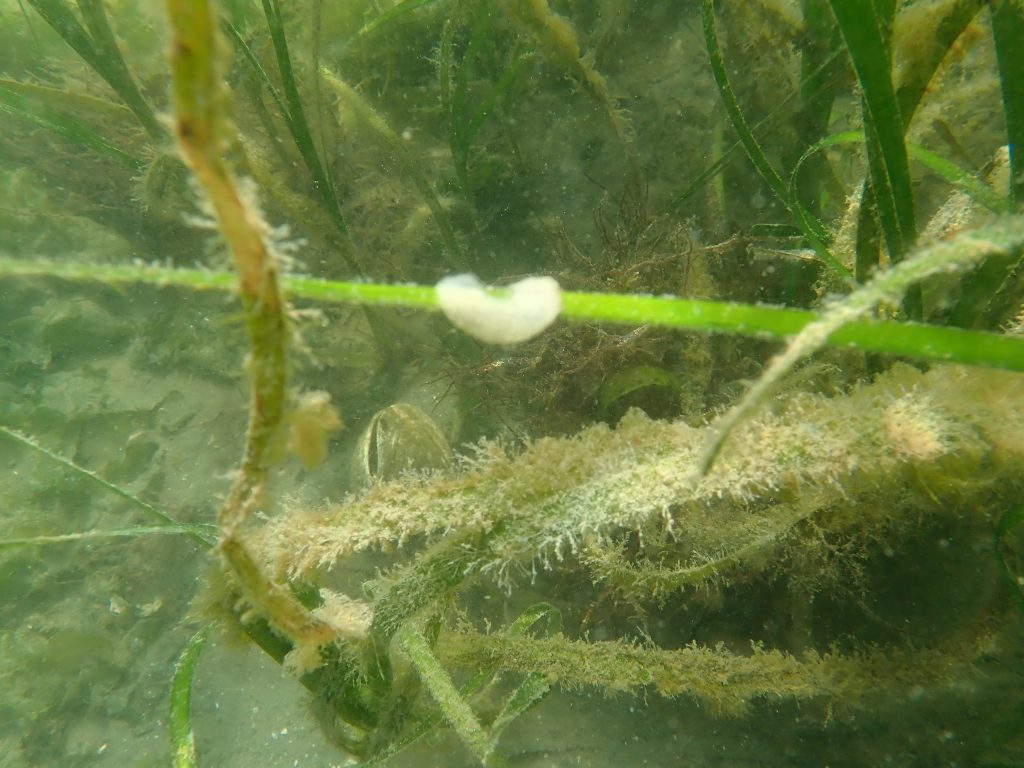
Eelgrass plays a vital role in coastal ecosystems. Its meadows offer foraging grounds and shelter for juvenile fish and invertebrates, provide food for migratory waterfowl, and serve as spawning site for species like pacific herring. By trapping sediment, stabilizing the seafloor, and softening wave energy, eelgrass beds also help protect shorelines from erosion. They form the foundation of an exceptionally productive marine food web.
This unique habitat generates food and oxygen, improves water quality by filtering polluted runoff, absorbs excess nutrients, and stores greenhouse gases such as carbon dioxide.




Why is eelgrass declining?
There are several known and suspected causes of eelgrass decline. It can be a challenge to figure out which ones are the most important. With each year of data collection, we get closer to figuring it out, but there are still a lot of questions unanswered. Below we discuss some of the things we think are driving eelgrass loss and why.
Competition For Light With Sea Lettuce (Ulva spp.)

In the shallow nearshore edge of eelgrass beds, we have observed sea lettuce competing directly with eelgrass for light. Often, sea lettuce creates a thick mat covering the eelgrass, and we suspect this is the leading cause of eelgrass decline along the shallow edges of eelgrass beds within our study area. Sea lettuces, of which there are several species known to SḴŦAḴ | Mayne Island, are annual species of green algae that can create extensive, thick mats under high nutrient conditions. These conditions are most likely to occur in bays with shallow, slow-moving water, and where there is a significant input of nutrients from the land, such as from agriculture or septic systems.
We have observed sea lettuce covering eelgrass in dense mats in the following locations: Village Bay, Gallagher Bay, Dinner Bay, Navy Channel Beach, and Grimmer Bay, North Pender Island. Observations at Village Bay are particularly interesting, because sea lettuce was removed from this area by the Village Bay Improvement Association each year from 2000 to 2019. Eelgrass declined in the same area from 2019 to 2022, a period of time when considerably less sea lettuce was being removed. Increases in sea lettuce growth, and resulting eelgrass decline, has been well documented other parts of the world.
What you can do to help: Ensure your septic system is working properly and not leaking into nearby water bodies such as streams or the ocean. Make sure your compost and manure piles are covered to avoid excess nutrients making their way into the ocean, and resulting in growth of competing algae.
Reduced Light From Shoreline Development

Erosion from development like building or digging along shorelines and in watersheds results in sediments settling on eelgrass beds, which lowers light availability for eelgrass. With increased severity and frequency of heavy rainfall events such as the one we experienced in the fall of 2021, the negative impact of sediments washing onto eelgrass beds is expected to increase. Retaining vegetation along shorelines and waterways is the best way to reduce erosion. When surface water is drained and directed into ditches, it typically moves faster and in greater volume, increasing its erosion potential and retaining suspended sediments. You can help mitigate this issue by, when possible, allowing water to slow down and spread out like it would naturally in an undeveloped ecosystem. Encouraging or creating natural wetlands and wet forests that help slow down surface water runoff is a great way to do this.
What you can do to help: Maintain forests and vegetation along creeks, streams, and shorelines to prevent erosion. Minimize sedimentation during construction activities by completing work in late spring or summer and initiating a re-vegetation plan immediately after construction. Use water-permeable surfaces on driveways and patios to reduce water flowing directly into the ocean.
Maintain and create wetlands. Wetlands capture and slow surface water flow into the ocean, instead allowing water to naturally filter into and replenish groundwater reservoirs. Drainage ditches and drainpipes conduct runoff, often containing sediment or excess nutrients, straight into the ocean.
Boat Wake Stirring Up Sediments

During our dive surveys, we have observed that water clarity (and light availability for eelgrass) greatly decreases within 3-8m of the shoreline every time a boat (usually a ferry) passes by because the waves stir up the sediments along the shore. In some locations, the boat traffic is frequent enough that this leads to a significant decrease in light availability for eelgrass in the shallow edge. We suspect this is a contributing cause of decline in eelgrass beds located near high traffic areas, particularly ferry routes.
What you can do to help: Drive slowly when boating through places where eelgrass beds are present.
Physical Damage From Anchor Chains

In some locations, mooring buoys are located in eelgrass beds. As the moored boats move back and forth in the wind and current, the heavy chain anchoring the buoy drags along the bottom, creating a circle on the seabed where no eelgrass grows. These patches are easily observed during our dive surveys. Please don’t anchor or install mooring buoys in eelgrass beds. Of the known human impacts to eelgrass, this is the easiest to identify, and the easiest to avoid.
What you can do to help: Avoid anchoring boats or installing docks and other structures in eelgrass meadows. Properly maintain your boating infrastructure to prevent derelict docks and boats. As we get into storm season, check that everything is secure.
Biological Factors

European green crab and seagrass wasting disease are two biological impacts to eelgrass that have been described in the region. We haven’t observed either of these in our survey sites to date, therefore we don’t think they explain the losses we have observed in the past 16 years. A third biological impact is grazing pressure and nutrient input by non-migratory Canada geese, which has greatly increased around Vancouver Island and the Gulf Islands since they were repeatedly and intentionally introduced between 1926 and 1991. The Capital Regional District is currently leading efforts to manage the regional population of non-migratory Canada geese.
What you can do to help: Be cautious of transporting invasive species – . Report sightings of European green crab. Clean, drain and dry watercraft and equipment used in the water before storing it or moving it to a different body of water. Never move species, organisms, water or objects from one body of water to another. Do not let loose any aquatic plants or animals such as bait or pets into municipal wastewater systems, man-made ponds (e.g., stormwater ponds) or bodies of water.
Moving Forward
Some causes of eelgrass decline are well known, such as the direct physical damage done by mooring and anchor chains. Other impacts, such as competition with sea lettuce, are not well understood. With the limited resources available to us, we are focusing on contributing to scientific knowledge of trends in local eelgrass abundance to inform decision making and further research. The Conservancy actively shares our monitoring results with local boaters to inform site selection for boat anchoring, and with the broader scientific community to support resource management and academic study. Our work has been used, and continues to be used, as an important dataset, and an example of how community-based environmental monitoring can contribute to science and conservation. Our data has been used by the following organizations:
University of Victora Spectral Lab
NETForce (National Eelgrass Task Force)
Seachange Marine Conservation Society
Want to get involved?
- Volunteer with the Conservancy as a Marine Citizen Scientist
- Learn more about eelgrass ecosystems and share your knowledge with friends and family.